
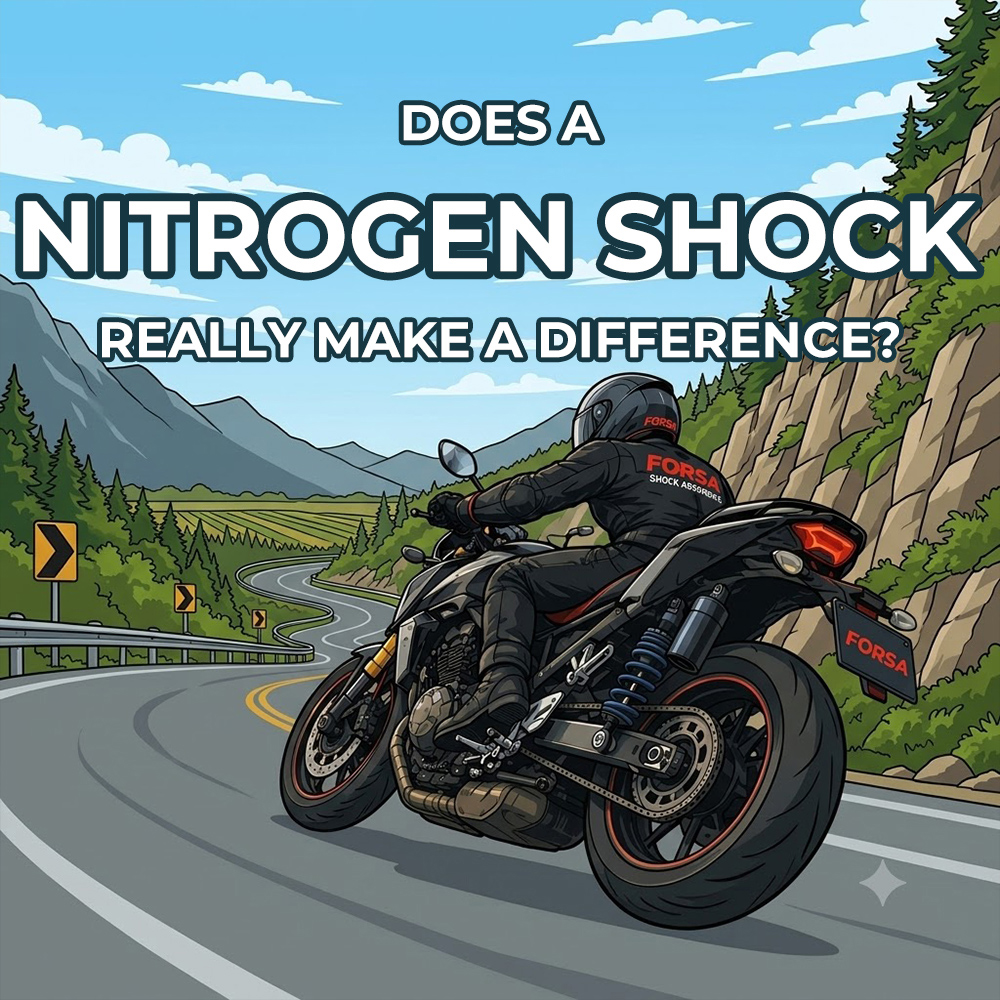
Does a Piggyback Reservoir Shock Absorber Really Make a Difference? A Mountain Road Test Makes Us Rethink the Importance of "Stability"

Why does the same mountain road feel completely different starting from the second run?

Early Sunday morning, the mountain asphalt is still damp with mist. A group of passionate riders gather to test their newly modified bikes.

During the first downhill run, every bike handles with perfect stability. Corner entry, apex exit, and acceleration—everything seems flawless.

However, by the third run, one of the bikes begins to show subtle changes. At high speeds through corners, the rear end starts to float. After a series of consecutive S-curves, the rebound speed becomes inconsistent, and that familiar sense of control gradually fades away. The rider hasn’t increased their speed, and the tires haven't changed. What truly altered was the internal state of the shock absorber due to prolonged operation.

This is a scenario that many heavy motorcycle enthusiasts, modified bike riders, and even racing teams have encountered. The real challenge doesn’t lie in the first lap, but whether the shock absorber can maintain consistent damping performance after sustained riding.

Piggyback reservoir shock absorber

Why Do Mid-to-High-End Modified Bikes Use Piggyback Reservoir Shock Absorbers?

During daily commuting on city roads, most standard shock absorbers handle basic bump absorption well enough. However, when the riding environment shifts to mountain roads, long-distance touring, track days, or aggressive riding, the shock absorber is subjected to continuous, high-frequency compression and rebound.

At this point, what truly impacts handling is no longer just the spring stiffness, but whether the damping can remain continuously stable. Therefore, many aftermarket brands and OEM manufacturers choose piggyback reservoir shock absorbers to ensure the suspension system maintains consistent performance under high loads.

What is a Piggyback Reservoir Shock Absorber?

A piggyback reservoir shock absorber features an independent oil/gas reservoir tank attached outside the main body, providing ample working space for the fluid and high-pressure nitrogen.

This design is not just for a sporty, high-performance look; more importantly, it prevents the performance degradation that usually occurs when a shock absorber operates for an extended period. For vehicles that require high-speed riding, long-duration use, or aggressive handling, this architecture effectively enhances damping consistency and overall control.

Why Do Tuning Enthusiasts and Racing Teams Choose Piggyback Reservoir Shock Absorbers?

True performance isn't measured at the very first turn, but by whether the shock absorber delivers the exact same feedback after dozens of consecutive corners. This is the greatest value of a piggyback reservoir shock absorber.

1. Customisable Fluid and Gas-Oil Combinations to Match Riding Needs

Different riding habits demand different suspension setups. Some riders prefer street comfort, others chase agile handling on mountain twists, and track racers require more direct, aggressive feedback. Piggyback reservoir shock absorbers allow the fluid configuration and gas-oil combination to be tuned according to specific use cases, ensuring the suspension response aligns perfectly with various riding requirements rather than being locked into a single fixed setting.

2. Minimised Cavitation for More Stable Damping

During continuous high-speed riding, the rapid movement inside the shock absorber can generate tiny bubbles within the fluid, a phenomenon known as cavitation. Cavitation causes a drop in damping force, leading to a "softening" effect or inconsistent feedback after prolonged use. Through high-pressure nitrogen and an oil-gas separation design via the piggyback reservoir, the probability of cavitation is significantly reduced, stabilizing damping performance and improving consistency during long rides.

3. Refined Suspension Feel and Precision Rebound Control

The true value of a premium shock absorber is not just about absorbing potholes, but finding the perfect balance between compression and rebound. Excellent rebound control keeps the tires firmly planted on the road surface, enhancing chassis stability during high-speed cornering, braking, and acceleration, while allowing the rider to easily master the vehicle's dynamics.

4. Solving Instability Issues During Long-Distance Rides

Many long-distance tourers share the same experience: at the start of the journey, the vehicle handles naturally and predictably. But after hundreds of kilometres of alternating highways and mountain passes, the suspension response starts to feel vague. This is not due to mechanical failure, but rather internal temperature spikes and damping fade caused by prolonged workloads. Designed with superior heat dissipation and effective oil-gas separation, piggyback reservoir shock absorbers mitigate performance decline, remaining stable even at the end of a long journey.

5. Multiple Configurations to Balance Performance and Comfort

Different brands and vehicle models have distinct suspension requirements. Consequently, piggyback reservoir shock absorbers offer versatile configurations based on product positioning—including variable damping settings, spring rates, and reservoir designs—helping brands build products that perfectly balance handling and comfort.

6. Reduced Internal Cavitation for Extended Service Life

When a shock absorber operates under high loads for long periods, minimizing cavitation does more than just maintain handling precision—it also reduces accelerated wear on internal components caused by a deteriorating operating environment. For OEM and ODM brands, this means the product retains stable performance over a longer lifecycle, significantly boosting overall durability and service life.

Comparison Matrix

Comparison Item Hydraulic Shock Absorbers Piggyback Reservoir Shock Absorbers
Target Audience General Commuting, Agricultural Machinery, Commercial Equipment Heavy Motorcycles, Modified Bikes, Racing, High-Performance Vehicles
Damping Stability Good Remains stable even after prolonged, heavy use
Rebound Control Basic setting Refined and adjustable based on specific needs
Long-Distance Performance Performance may degrade over extended periods Effectively mitigates performance decline and fade
Cavitation Phenomenon More prone to occurring Effectively reduced and suppressed
Customisation Capability Medium High, completely tailorable to brand specifications
Ideal Application Daily Roads Mountain Roads, Race Tracks, Performance Riding

Reminder: Not every vehicle requires a high-performance piggyback reservoir shock absorber. When selecting a suspension system, the design and type should be chosen based on vehicle positioning, riding habits, operating environments, and specific product requirements.

OEM & ODM Development: Beyond Pure Performance to Match Brand Positioning

Different brands have different design objectives for their suspension. Throughout the OEM/ODM development process, the engineering team plans the ideal damping curves, gas-oil distribution, and rebound characteristics based on vehicle weight, suspension geometry, intended riding use, target markets, and performance requirements—rather than simply treating "the stiffer, the better" as the ultimate design goal.

A Great Piggyback Reservoir Shock Absorber Changes Your Confidence in Every Corner

To those who love to ride, a shock absorber is far more than just an aftermarket mod. It dictates your stability every time you brake, your support every time you lean into a corner, and whether your vehicle maintains consistent handling at the end of a grueling long-distance trip.

With its advanced oil-gas separation design, rock-solid damping control, and high customisability, the piggyback reservoir shock absorber has become an essential choice for heavy motorcycle brands, performance models, and racing teams alike. For OEM and ODM clients, an outstanding piggyback reservoir shock absorber does not simply elevate performance—it is a vital key to product differentiation and market competitiveness.

Frequently Asked Questions (FAQ)

Q1: What types of vehicles are piggyback reservoir shock absorbers suitable for?

A: Piggyback reservoir shock absorbers are widely used in heavy motorcycles, performance scooters, modified vehicles, ATVs, UTVs, off-road bikes, and race cars that demand high stability and precise handling. They can also be custom-engineered to meet specific OEM/ODM project requirements.

Q2: What is the main function of a piggyback reservoir shock absorber?

A: The piggyback reservoir tank provides expanded working space for the fluid and nitrogen gas. This design helps suppress cavitation and improves heat dissipation efficiency, allowing the shock absorber to maintain stable damping performance even after long periods of heavy use.

Q3: Are piggyback reservoir shock absorbers always better than traditional hydraulic ones?

A: Not necessarily. Traditional hydraulic shock absorbers hold clear advantages in terms of durability, cost-efficiency, and ease of maintenance for daily applications. Piggyback reservoir shock absorbers, however, are superior in scenarios that prioritize precision handling, high-speed stability, and prolonged high-load operation.

Q4: Can OEM/ODM setups tune the shock absorber settings according to specific brand requirements?

A: Yes, absolutely. Custom development can be tailored precisely around vehicle weight, intended application, mounting space, damping curves, rebound speed, spring coefficients, and piggyback reservoir configurations, helping brands create suspension systems that align perfectly with their market positioning.